
Building Real Sensors with GF180MCU
As we get closer to our December 3rd tape-in deadline (that’s coming up fast!), I wanted to share something that really shows the power of what you can build with the GF180MCU process we’re pooling together.
Real Silicon, Real Applications
Saligane’s group at the University of Michigan - now at Brown University - recently published a paper in IEEE Solid-State Circuits Magazine showing off an analog front-end (AFE) chip they designed entirely with open-source tools on GF180MCU. And it’s not just a test chip — they’re using it to read out flexible laser-induced graphene sensors for wearables!
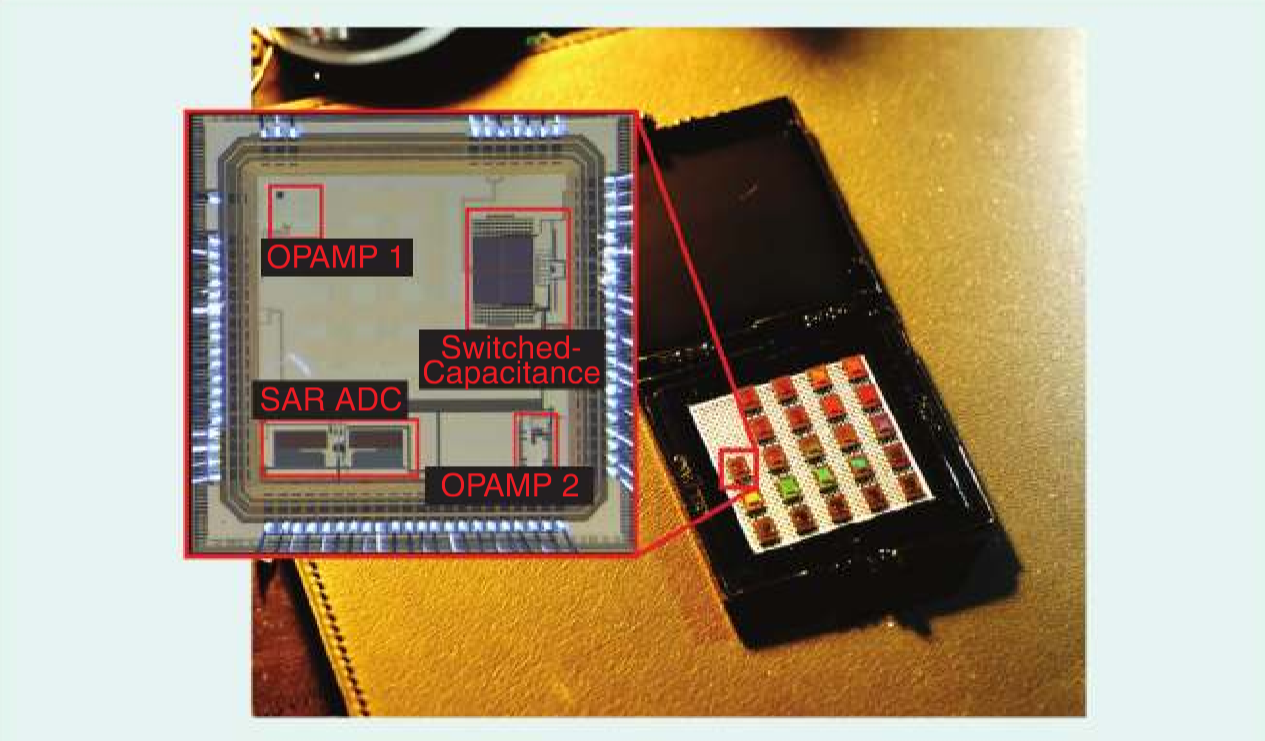
The fabricated GF180MCU chip showing OPAMP blocks, SAR ADC, and switched-capacitance circuits
(View high-resolution die photography on Silicon Prawn)
The chip integrates operational amplifiers, a 14-bit SAR ADC, and a capacitive DAC to create a complete sensor readout platform. They demonstrated it working with:
- Strain/flex sensors (detecting finger bending in real-time)
- Temperature sensors (tracking body temperature with 0.9989 R² accuracy)
- Multi-modal sensing (combining different sensor types on one platform)

The fabricated chip wire-bonded to a PCB, ready to interface with flexible sensor patches
The Open Source Flow Works!
What’s exciting is they used the exact same open-source toolchain you have access to:
- XSchem for schematic capture
- Ngspice for simulation
- KLayout and Magic for layout
- Standard DRC/LVS checks
They’ve published their designs on GitHub in the OpenFASoC-Tapeouts repository, and the final submission is available on foss-eda-tools, which means you can actually look at exactly how they did it.
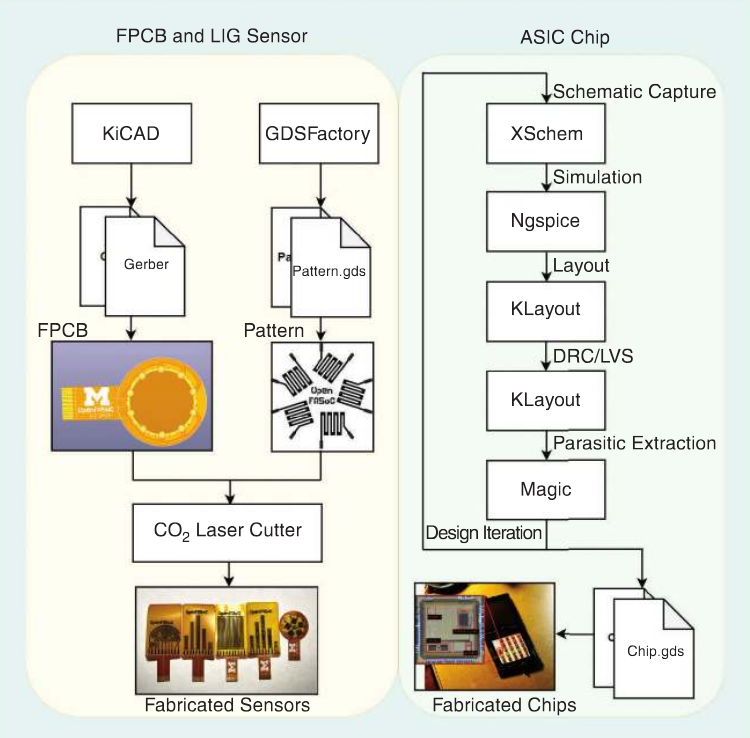
The complete open-source analog design flow used for this project
Reuse, Don’t Reinvent!
This is where it gets really interesting for your designs. The OpenFASoC project provides building blocks you can directly reuse:
- Folded-cascode OPAMP with programmable bias for noise/power trade-offs
- 14-bit SAR ADC (asynchronous, monotonic switching)
- Bootstrapper and switch circuits for high-performance sampling
- Comparator circuits (double-tail latch and StrongArm topologies)
You can literally take their GDSII files, study their layout techniques, and adapt their circuits for your own sensor applications. Need to read out a resistive sensor? Temperature probe? Custom transducer? The hard work of building reliable analog blocks is already done.
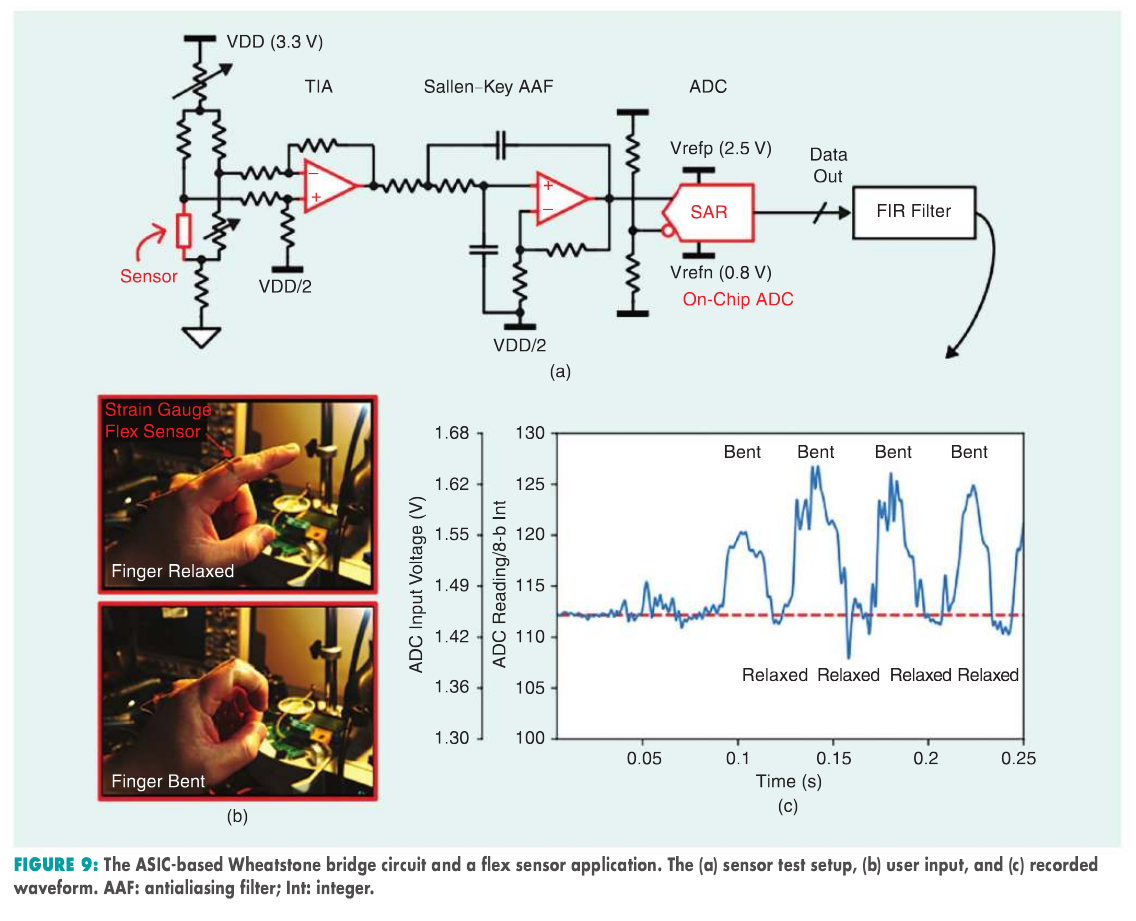
Real-time flex sensor demonstration showing finger bending detection with the AFE chip
What Could You Build?
Think about applications like:
- Environmental monitoring devices
- Biomedical wearables
- Industrial sensor nodes
- Custom instrumentation
- IoT edge devices with analog sensing
With GF180MCU’s 5 metal layers, MIM capacitors, multiple resistor types, and mixed-signal capabilities, you have everything needed for serious analog and mixed-signal designs.
Get Inspired, Get Building
Check out the full paper to see detailed schematics, measurement results, and their complete design flow. This is real silicon, designed with open tools, doing real work — exactly what we’re enabling with this pooled run.
For questions about the campaign or getting started with GF180MCU, join the community on Discord or Matrix.
Reserve your slot at buy.wafer.space before November 28th to be part of Run 1.
This update was originally published on Crowd Supply.